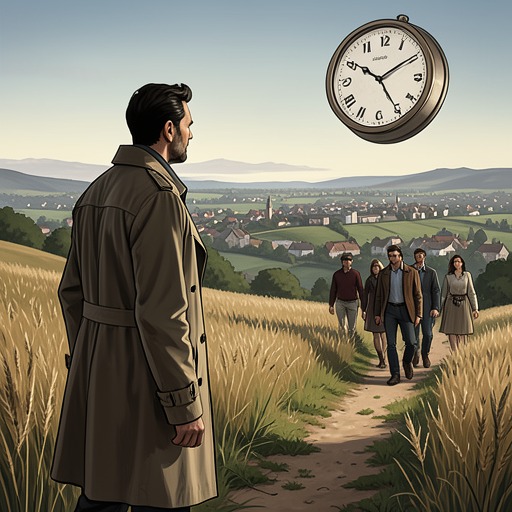
A wilderness of mirrors
Killers of the Flower MoonA wilderness of mirrors is both a chapter heading and the governing metaphor for the uncertainty confronting T. B. White’s investigation of the Osage murders. The phrase describes more than a maze of clues: information itself had become suspect, as leaks exposed the inquiry and possible intermediaries seemed to conceal as much as they revealed. In that atmosphere, finding a lead meant asking who had supplied it, what they stood to gain, and whether the investigation was being watched from within.
The Investigation Turns Inward
By the end of the summer, T. B. White suspected that someone inside the investigation was passing information outward. An attorney questioned by one of White’s agents displayed an alarming knowledge of the case’s inner workings and acknowledged having seen part of the Bureau of Investigation’s reports, with an opportunity to see more. The suspicion was not isolated: reports were reaching unauthorized people, and material furnished to a U.S. attorney had disappeared from his office. The inquiry’s documents, meant to establish what had happened, had become evidence of a second danger—the possibility that the investigation itself was compromised.
That vulnerability altered the investigators’ working conditions. White sometimes met his team at night in the countryside, where the men gathered in the dark. Agents had previously sensed that they were being followed, and White prepared his men for the possibility that their cover might fail, advising restraint where possible while making clear that they should be ready to defend themselves. The investigation thus took on the character of espionage: its agents were pursuing murder suspects while also trying to protect their own movements and information.
Pike and the Withheld Witness
The expression’s mirror-like uncertainty gathers around Pike, a private investigator who had been hired by William K. Hale in 1921 to solve the Osage murders, then abandoned the case without making progress. An intermediary later told Agent Burger that Pike had withheld a significant discovery: he knew the identity of the third man seen with Bryan Burkhart and Anna Brown around the time Anna was killed. According to the intermediary, Pike had known and spoken with that man.
Pike did not offer the information freely. He would share it only for a very large payment, and he failed to come forward when agents pressed him through the intermediary. His withholding transformed a potentially clarifying lead into another source of uncertainty: the investigators had to consider whether he was extorting them, obstructing justice, or acting under someone else’s influence. Agent Burger’s report characterized the situation as crooked work, but the identity and motives of whoever might be behind it remained unresolved in this episode.
Meaning of the Metaphor
The chapter’s image of mirrors fits a case in which apparent access to the truth repeatedly produces another layer of doubt. A report can be copied and leaked; an attorney may know the investigation from unauthorized sources; a supposed go-between may be carrying a genuine lead while bargaining for money. Even Pike’s knowledge does not settle the question of the third man: it confirms that someone may possess the missing information, while making the investigators’ dependence on that person more precarious.
The agents’ response was to pursue Pike rather than accept his terms. His last known address was in Kansas City, but it changed after he learned that the investigators were looking for him. They believed he might have been paid to disappear and began a manhunt to locate him. The phrase therefore names both the atmosphere and the method of this stretch of the inquiry: each reflection offers a possible view of the truth, but none can be trusted without testing who stands behind it.